
China, which has territorial disputes with many countries in the strategic Indo-Pacific region, has been opposing the Quad alliance since its formation.
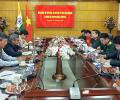
The 15th India-Vietnam Defence Dialogue signalled a move from routine talks to deeper cooperation, with new deals on submarine rescue and defence industry to support stability in the Indo-Pacific, notes Dr Rajaram Panda.

Bolton said that the arguments for China joining the World Trade Organisation was that it would become a more market-oriented rules-based society.

China on Thursday questioned the Japanese premier's assertions claiming sovereignty over disputed islands in East China Sea, saying Tokyo is 'self deceiving itself' by ignoring historical facts and international laws.

China has dispatched two of its maritime security vessels to patrol the waters of disputed islands in the Pacific Ocean, amid attempts by Japanese politicians to buy land there.

President Biden has been forced to turn his attention to domestic politics, as he works to hash out a deal with Republicans to prevent the US from defaulting on its debts at the end of this month.
Hardening its stand on the dispute with Japan over the islands in East China Sea, China has said it will take "forceful" measures in response to any move that challenges the country's sovereignty. "We want to live in friendship with all countries including Japan, but we have to uphold our principles and bottom line," Chinese Vice Foreign Minister Zhang Zhijun told the media.
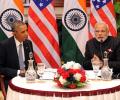
India has moved beyond the traditional trappings of non-alignment
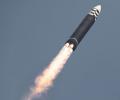
This is the first time in decades that China has made its flight test of an intercontinental ballistic missile public in an apparent show of strategic deterrence, State-run China Daily reported.
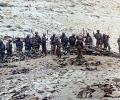
Pompeo explains how the Donald Trump administration succeeded in bringing India on board the Quad grouping.
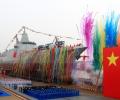
It is equipped with new air defence, anti-missile, anti-ship and anti-submarine weapons.
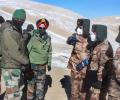
"China creeps towards hegemony in Asia, threatens India's borders, and treats other countries as junior partners, Indian-American Congressman Ro Khanna said.
In a surprise move China's State Oceanic Administration (SOA) announced that a maritime surveillance fleet consisting of two patrol vessels, Haijian 50 and Haijian 66 started patrolling the waters of the Diaoyu Islands since Friday

US President Joe Biden and his Chinese counterpart Xi Jinping on Monday held their first in-person meeting in Bali, with both leaders underscoring the need to manage their differences and prevent a conflict, amid Beijing's coercive military posturing against Taiwan and in the strategic Indo-Pacific region.
Amid growing confrontation between China and Japan over a group of uninhabited islets in the East China Sea, Chinese government will be briefing the Indian government regarding its case.
Thousands of Chinese protesters on Saturday pelted stones at Japan's embassy in Beijing amid growing tensions between the two sides over a group of islands in East China Sea, where surveillance ships dispatched by Beijing asked Japanese Coast Guard vessels to leave the disputed area or face consequences.

The Quad has come of age and its agenda covering areas like vaccines, climate change and emerging technologies makes it a force for global good, Prime Minister Narendra Modi said at the first summit of the coalition. In his opening remarks, he also talked about shared values and promoting a secure, stable and prosperous Indo-Pacific.

What we are watching is something different: A fog manufactured and maintained by the people who started the war, so that the question of why it was started never has to be answered, observes Prem Panicker in his must read blog on the war in the Middle East.
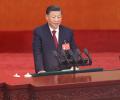
'No Cold War should be reignited and no Ukraine-style crisis should be repeated in Asia'

China has issued a red alert as it braced for Typhoon Fitow, with tens of thousands evacuated as the storm is set to slam the country's eastern coast soon.
After months of high profile military posturing over the disputed islands with Japan, China said it attaches importance to the ties with Tokyo and called on the Japanese government to resolve the dispute through dialogue to keep the relations on track.

The remarks of White House Press Secretary Jen Psaki came ahead of the 14th round of military-level talks between India and China on the 20-month row in eastern Ladakh.
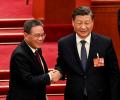
'The real issue between India and China is that the Chinese have transgressed along the Line of Actual Control at multiple points.'

This includes over $15 billion of proposed investment in the infrastructure sector in the Indo-Pacific and $9 billion for shoring up American defence in the region.
Tensions between China and Japan over disputed islands in the East China Sea intensified on Tuesday after two armed Chinese maritime vessels reached close to the area protected heavily by the Japanese coast guard.
Clinton, who lost to President Donald Trump in the 2016 elections, claimed that both Russia and China are benefitting from his weak foreign policy.

The sale of 10 AGM-84L Harpoon Block II air-launched missiles is estimated to cost $92 million (Rs 699 crore), while 16 MK 54 All Up Round Lightweight Torpedoes and three MK 54 Exercise Torpedoes are estimated to cost $63 million (Rs 478.8 crore), the Defence Security Cooperation Agency said on Monday in two separate notifications to the Congress.

He said that "the state of the border will determine the state of the relationship, that's natural".

Less than a month after the historic visit of Prime Minister Narendra Modi to the US, a Congressional senatorial Committee has passed a resolution recognising Arunachal Pradesh as an integral part of India.
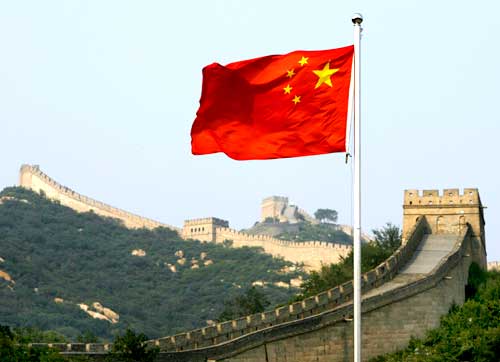
Asking the US to respect the efforts by China and India to resolve their boundary dispute peacefully, a top Chinese official on Monday said the two nations are wise enough to deal with it after the Pentagon accused Beijing of deploying more troops along the Sino-India borders.

'Our record and our actions and stances is fairly clear and by criticising it repeatedly, it doesn't make us less credible'

In a stern message to its neighbours, China today said it is determined to defend "every inch" of its territory and there was "no room for compromise" with Japan over territorial or historical disputes.
The remarks by the Chinese foreign ministry came a day after Secretary of State Mike Pompeo assured India that the US stands firmly with it to confront threats to its sovereignty.
The US House of Representatives and the Senate on Tuesday passed the National Defense Authorization Act (NDAA), which included key components of Indian-American Congressman Raja Krishnamoorthi's resolution language urging the Chinese government to end its military aggression against India along the LAC.
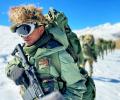
The United States will continue to support India with equipment and other things it needs along the Line of Actual Control (LAC) with China, a top American admiral has told lawmakers, asserting that Washington and New Delhi share a 'tremendous partnership'.

China on Thursday ruled out establishing an air defence zone along the India-China border like it recently did over the disputed islands in the East China Sea, saying such zones are created only in coastal areas beyond territorial airspace.

Moody's Ratings on Tuesday cut India's GDP growth projections for 2025 to 6.3 per cent, from 6.5 per cent, saying economies globally will see a slowdown on account of heightened US policy uncertainty and trade restrictions.

According to the Pentagon report, the PLA is creating options for dissuading, deterring, and defeating external intervention in the Indo-Pacific region.
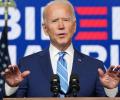
Biden on Friday opened the first Quad Leaders' Summit held virtually and attended by Prime Minister Modi, Australian Prime Minister Scott Morrison and Japanese Prime Minister Yoshihide Suga.

China on Thursday sent several fighter jets and an early warning aircraft to its newly declared air defence zone in the East China Sea as a "defensive measure" after Japan and South Korea said their military planes flew through the area in defiance of Beijing's unilateral move.
